By Chef Alexis Hernandez
When I lived in Atlanta, I must have driven past Southern Baked Pie Company on Peachtree Road dozens of times before finally stopping in.
One afternoon, Marty and I decided to see what all the fuss was about. Inside were beautiful pies, some freshly baked and others frozen that you could take home and bake yourself. We picked up a few smaller pies, a pecan pie, and then I spotted something I wasn’t expecting, a tomato pie.
Now, I’m not Southern, and I didn’t grow up eating Southern food. I’m of Cuban descent, and savory pies weren’t exactly something we had on the dinner table.
Even when I was first introduced to shepherd’s pie and chicken pot pie, I found the idea of putting dinner inside a pie crust a little strange. Marty, on the other hand, grew up with Southern food. He wanted the tomato pie, so into the bag it went.
We were having a cocktail party at the house, and I decided to serve slices of the pie as one of the appetizers. It wasn’t something I would normally serve. Just a slice of savory pie sitting on a plate, without a sauce or garnish or anything else to dress it up.
People were curious.
“Tomato pie? What’s in it?”
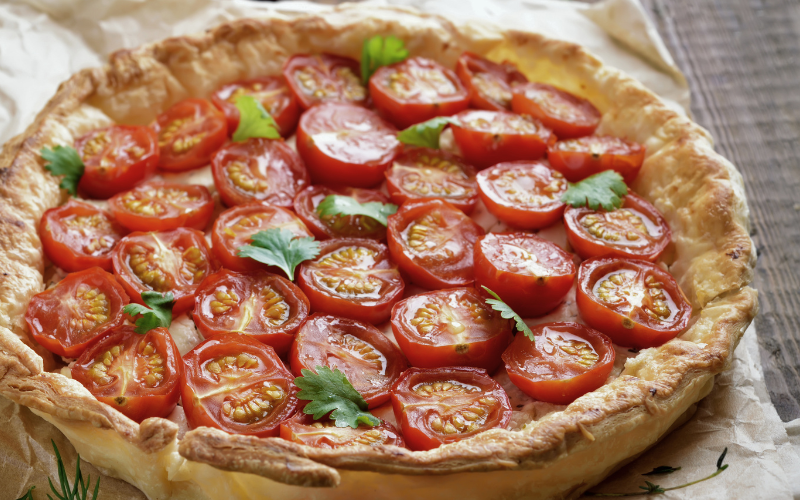
Tomatoes, cheese, onions all in a pie crust.
You could see some hesitation. Then they tasted it and everyone loved it. A few people asked whether I’d made it myself. I wish I could have said yes, but I told them it came from a place called Southern Baked Pie Company.
“Really? This is delicious!”
I thought so, too.
And that was the beginning of my rather long relationship with tomato pie.
There’s a Reason People Line Up for Pie
I’ve been back to Southern Baked Pie Company many times since that first visit. Around the holidays, I’ve seen cars lined up with people picking up their orders. Thanksgiving, Hanukkah, Christmas. People know where to go when they want a good pie.
Are they more expensive than the pies you’ll find at Publix or Kroger? Of course.
But you’re paying for more than flour, butter, and filling.
You’re paying for someone’s knowledge, experience, and ability to make something consistently good. When you don’t have to make it yourself for a holiday dinner or entertaining a house full of people, that’s worth paying for.
There’s a wonderful feeling that comes with picking up one of those pies, putting it in the car, and driving home knowing that part of your menu is taken care of. You know it’s going to be good, and you didn’t have to spend the afternoon making it.
I’ve never had a problem paying for that.
And her pies really are excellent. I haven’t tried every one Amanda Dalton Wilbanks makes, but everything I’ve had has been very good.
The tomato pie, though, is the one that got me.
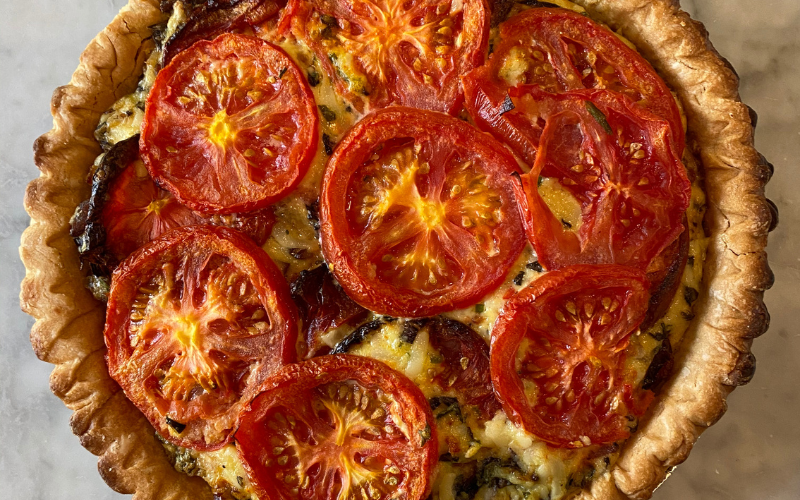
The balance is what I love most. The tomatoes are the main event, with just enough onion to complement them and the cheese doesn’t overpower everything. The crust well, it’s sturdy enough to hold a filling made primarily of tomatoes, yet somehow it remains flaky and buttery. It has a particular texture that feels intentional, like someone has spent a great deal of time figuring out exactly how it should be.
Which, of course, someone has.
My First Attempt Was a Soggy Mess
Being a chef, I eventually decided I wanted to make a tomato pie that could rival Amanda’s.
Naturally, I went online looking for her recipe and found some information about ingredients and tomatoes, but not the complete method for the tomato pie I’d been buying.
So I figured I’d give it a shot.
I bought one of those large frozen pie crusts at the grocery store, sliced some tomatoes, put together a filling, and baked it.
It was okay.
Actually, it was pretty soggy.
I hadn’t salted the tomatoes to draw out their water or roasted them to remove additional moisture or concentrate their flavor. I didn’t really give the crust much consideration, either.
I figured I knew how to cook. How hard could a tomato pie be?
Apparently, harder than I thought.
I began taking it more seriously, researching moisture content, different varieties of tomatoes, pastry techniques, and what happens when all those ingredients come together in the oven.
I remember the first time I made one and the bottom crust wasn’t soggy. I thought, well, at least I’ve solved one of the problems.
But I still couldn’t reproduce the flakiness of Amanda’s pastry.
And honestly, pastry and I have had a complicated relationship for a long time.
Where it all started
My troubles with baking didn’t end there, either. I was eliminated from Food Network Star because of soggy doughnuts. I went on to win Cutthroat Kitchen, only to be eliminated from its Evilicious tournament because of another doughnut.
Apparently, doughnuts and I have some unfinished business.
I’m a savory chef. Put me in front of a stove, and I’m pretty comfortable. Baking is another discipline entirely.
In professional kitchens, we call baking recipes formulas. Ingredients are measured by weight, and ratios matter. When you’re cooking something savory, you can usually taste it and make adjustments. A little more salt, some acid, another few minutes on the stove.
Pastry isn’t quite so forgiving.
I’ve always had tremendous respect for bakers. I understand the science behind baking, but knowing the theory and having years of experience working with dough are very different things.
The Recipe Is Only Part of It
I eventually discovered that Amanda had actually published her pie crust recipe.
I haven’t made it.
I’ve spent years developing my own crust, and there’s something valuable to me about all the time, thought, and testing I’ve put into it.
Besides, having someone’s recipe doesn’t necessarily mean you’re going to make it exactly the way they do.
There are things that don’t always make it onto the page. How the dough feels in your hands. What the butter looks like before adding the water. Knowing when you’ve worked the pastry enough, or perhaps a little too much.
Those little details come from experience.
I think about Whitney Houston.
Someone else can sing the same song. They can follow the same arrangement, sing the same words, and hit every note. They might even do a beautiful job.
But it’s not Whitney Houston.
Cooking is like that.
Think about something your mother or grandmother made when you were growing up. You might have the exact recipe, written in their own handwriting, and somehow it never tastes quite the same when you make it.
I think there’s something wonderful about that.
I’ve gotten pretty close to the flavor of Amanda’s tomato filling, but I still haven’t reproduced that crust. And even if I eventually do, it won’t be quite the same pie.
That’s okay.
There’s Room for Both
It’s been years since that afternoon on Peachtree Road, and tomato pie is still part of my cooking rotation when tomatoes are in season.
I don’t work on it every day. Sometimes months go by before I make another one. But every time I do, I find myself thinking about the last attempt, what worked, and what I might change.
And somewhere along the way, my version became something I genuinely enjoy making.
Amanda’s pie is still the one I’ll buy for a special occasion. Thanksgiving, Christmas, Hanukkah, or the Fourth of July. I know exactly what I’m getting, and I’m happy to let someone who has mastered her craft take care of that part of the menu.
Mine is the one I’ll make when we’re having friends over for cocktails, or when it’s August and a slice of tomato pie with a glass of Chardonnay sounds like a perfectly good dinner.
I like knowing there’s room for both versions.
The recipe I’m sharing below is still a working recipe. I’ve made plenty of tomato pies over the years, but this particular version includes some techniques and adjustments I’m still experimenting with. I haven’t finished testing the exact formula, and I’m sure there will be changes.
And I’d love to hear from anyone who’s been making tomato pie longer than I have.
Do you roast your tomatoes? Salt and drain them? Have a particular trick for keeping the bottom crust crisp? Maybe you’ve tried this recipe and found something that works better.
Shoot me a note on Instagram at @mrchefalexishernandez.
I genuinely enjoy learning how other people cook.
I’ve kept files of techniques I’ve picked up from other chefs and home cooks over the years. Sometimes it’s something I end up using, and sometimes it isn’t, but I’m always interested.
As for Amanda, I’m still a fan.
Her tomato pie is hers and Mine has become mine.
I probably wouldn’t have spent all these years learning how to make it if I hadn’t walked into her shop on Peachtree Road that afternoon.
Southern Tomato Pie — A Working Recipe
Inspired by Amanda Dalton Wilbanks and Southern Baked Pie Company.
This is my current working formula, incorporating techniques I’ve learned over years of experimenting with tomato pie. The exact version below is still being tested and may change as I refine it.
Ingredients
All-Butter Pie Crust
- 1¼ cups (160 g) all-purpose flour
- ½ teaspoon Diamond Crystal kosher salt
- ½ teaspoon granulated sugar
- 10 tablespoons (142 g) cold unsalted butter, cubed
- 3–5 tablespoons (45–75 ml) ice water
Tomato Filling
- 2½ pounds (1.13 kg) ripe tomatoes, preferably a combination of beefsteak and Roma
- 1 medium Vidalia onion, thinly sliced
- 1 tablespoon unsalted butter
- 1 large garlic clove, minced
- 1 teaspoon Diamond Crystal kosher salt, divided
- ½ teaspoon freshly ground black pepper
Cheese Topping
- 1 cup (113 g) freshly grated sharp white cheddar, divided
- ½ cup (57 g) freshly grated Gruyère
- ½ cup (115 g) Duke’s mayonnaise
- 1 tablespoon finely grated Parmesan
- ¼ teaspoon freshly ground black pepper
For Sealing the Crust
- 1 large egg white
- 1 teaspoon water
Method
1. Make the pastry
Combine the flour, salt, and sugar. Work in the cold butter, leaving some pea-sized pieces and a few larger flattened pieces. Add the ice water gradually, mixing just until the dough holds together when pressed.
Shape into a disk, wrap, and refrigerate for at least 1 hour.
Roll the dough approximately ⅛ inch thick and fit into a standard 9-inch metal pie plate. Trim and crimp the edges, then refrigerate for another 30 minutes.
2. Salt and drain the tomatoes
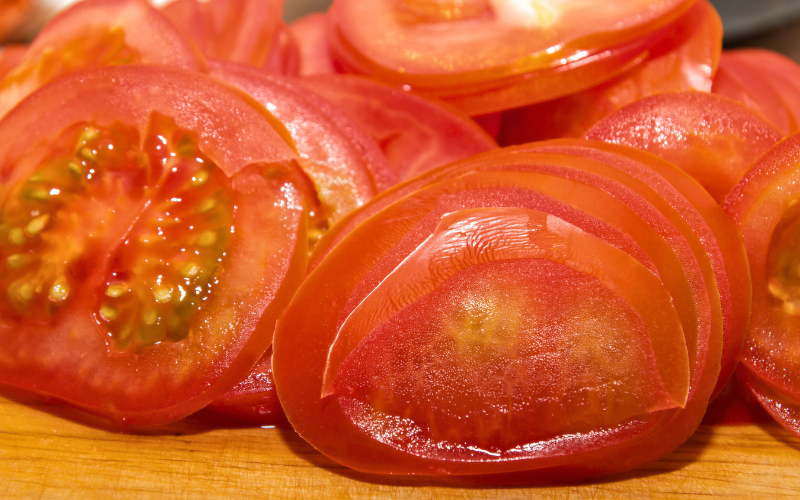
Core the tomatoes and slice approximately ¼ inch thick. Remove large pockets of loose seeds and gel without destroying the slices.
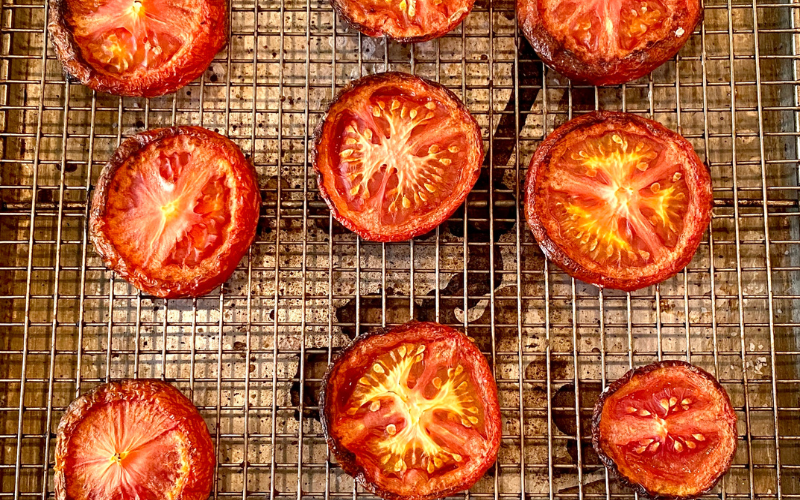
Arrange the tomatoes in a single layer on a wire rack set over a rimmed sheet pan. Sprinkle evenly with ¾ teaspoon kosher salt and allow to drain for 30 minutes.
Blot both sides thoroughly with paper towels.
3. Gently roast the tomatoes
Preheat the oven to 325°F.
Transfer the tomatoes to parchment-lined sheet pans, leaving space between slices. Roast for approximately 30–40 minutes, checking after 25 minutes.
The tomatoes should lose some moisture and become slightly concentrated while remaining tender and intact. If liquid pools heavily during roasting, carefully drain it away.
Cool completely, then blot again.
The goal isn’t to make sun-dried tomatoes. We want recognizable tomato slices that have lost some of their excess water.
4. Cook the onions
Melt the butter in a skillet over medium-low heat. Add the Vidalia onions and remaining ¼ teaspoon salt.
Cook for 12–15 minutes, stirring occasionally, until soft and lightly golden. Add the garlic during the final minute.
Continue cooking briefly if any liquid remains in the pan. Cool completely.
5. Blind-bake the pastry
Increase the oven temperature to 400°F.
Line the chilled crust with parchment and fill with pie weights, making sure they support the sides.
Bake for 18–22 minutes, until the edges are set.
Remove the weights and parchment. Return to the oven for another 10–15 minutes, until the bottom is uniformly golden and dry.
6. Seal the crust
Lightly beat the egg white with 1 teaspoon water.
Brush a very thin layer across the bottom and slightly up the sides of the hot pastry. Return to the oven for 2–3 minutes, until the coating is set and dry.
Cool on a wire rack.
This creates a thin moisture-resistant barrier. It’s an additional precaution, not a substitute for removing moisture from the tomatoes.
7. Prepare the cheese mixture
Reserve ¼ cup of the cheddar for the bottom of the pie.
Combine the remaining cheddar, Gruyère, mayonnaise, Parmesan, and black pepper in a bowl.
Mix until thick and evenly incorporated.
8. Assemble the pie
Reduce the oven temperature to 375°F.
Sprinkle the reserved cheddar across the bottom of the cooled pastry.
Arrange half of the roasted tomatoes over the cheese. Distribute the cooled Vidalia onions and garlic evenly over the tomatoes.
Add the remaining tomato slices, then gently spread the cheese mixture across the top.
Avoid compressing the filling or packing it above the pastry rim.
9. Bake
Place the pie on a rimmed baking sheet and bake at 375°F for approximately 25–35 minutes.
The cheese should be golden, and the filling should bubble gently around the edges. Shield the pastry edges with foil if necessary.
10. Rest and serve
Transfer to a wire rack and allow to rest for at least 45–60 minutes before slicing.
Serve warm or at room temperature.
A glass of Chardonnay is entirely appropriate.
A Few Notes From My Kitchen
The tomatoes: Moisture is the biggest challenge. Salting and gentle roasting are intended to concentrate flavor without destroying the texture.
The crust: Fully blind-baking, followed by a thin egg-white seal, should help protect the bottom pastry.
The onions: Vidalias bring sweetness to the filling. I prefer cooking them gently rather than deeply caramelizing them.
The cheese: Sharp cheddar provides flavor, Gruyère brings richness, and Parmesan adds another savory note. The mayonnaise helps bring the mixture together.
The next test: I’ll be paying particular attention to the bottom crust, the texture of the roasted tomatoes, and how the filling sets after cooling.
This is a working recipe rather than a finished, repeatedly tested formula. If you try it, I’d love to hear what worked, what didn’t, and what you would do differently.
Find me on Instagram: @mrchefalexishernandez.