The Book I Didn’t Set Out to Write
By Chef Alexis Hernandez
I recently had a conversation with Makenzie Atkins Noel from the Osprey Observer about my new book, What the Pan Remembers. We talked about growing up in New Jersey, cooking professionally, and how I ended up writing a book of essays.
But there was something we didn’t get around to.
I wasn’t supposed to write this book. At least not the one I ended up writing.
When I was putting together my first cookbook, Conversation Starters: From The Other Side of the Stove, my publisher at Archway suggested I remove a large section of recipes. There were already quite a few in the book, and this particular section didn’t really fit with everything else.
They were recipes from my childhood. Lechón asado, yuca, the black beans my father used to make. All those Cuban dishes I grew up eating.
So I took them out and set them aside for another time.
After the cookbook was published, I started working on them again. I figured I’d write another cookbook, this time about Cuban and Latin food. Maybe I’d tell longer stories about the recipes and then include the recipes themselves.
Except I kept writing and the stories about the recipes wanted more than just a couple of sentences. The food stories and memories wanted pages.
I’d start with something my father cooked, and before I knew it, I was remembering something else. A person who was there, something that happened around the table, or some little observation that had nothing to do with how much garlic confit went into the pot.
Suddenly, what was supposed to be a short introduction was several pages long.
I thought maybe I could write a book with these longer stories followed by recipes. I showed the idea to some chef friends. They weren’t so sure anyone would read it. A few creative friends thought it was interesting, maybe even something different. Then I asked my family and the people closest to me.
Most of them weren’t convinced either.
So I kept thinking about it. Why was I trying so hard to attach recipes to these stories? Maybe I should just write the stories.
And that’s what I started doing.
Of course, that brought another round of questions.
“You’re not going to include any recipes? Not even one at the end of each essay?”
No. I wasn’t.
I was a little concerned. After all, I’m a chef, and people expect chefs to write cookbooks. But I couldn’t see the point of adding a recipe simply because that’s what people expected from me.
Besides, I liked writing.
I actually learned quite a bit about it years before I ever worked in a professional kitchen. In the late 1980s, I attended Moody Bible Institute and later seminary, where I spent an enormous amount of time writing papers. Sometimes we had to defend a theological position, then turn around and argue the other side. I enjoyed the research, but what I really liked was finding the angle. How could I approach the subject differently? What was the argument I wanted to make?
And this was back when I was doing all that writing on a typewriter.
I still enjoy sitting down in the morning and figuring out what I want to write about. Sometimes I have an idea but no idea where it’s going. I’ll spend more time thinking about the angle than actually writing the first paragraph.
I went to Moody to study theology and learn how to preach. I certainly wasn’t sitting at a typewriter thinking I’d someday be writing essays about Chef Boyardee ravioli.
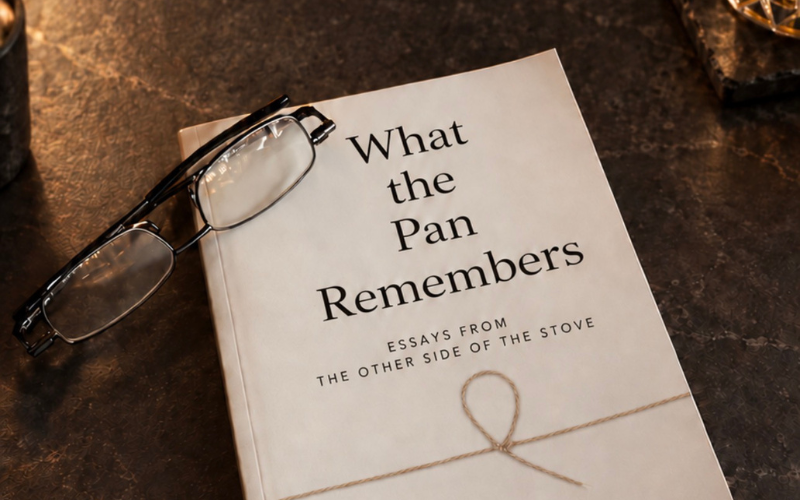
Somewhere along the way, I had come up with the title What the Pan Remembers.
I liked the idea that a pan is always there. It doesn’t matter whose kitchen it is or what you’re cooking. It’s there when you make a mistake, when you take a shortcut, when you spend all afternoon preparing dinner, or when you bring home a rotisserie chicken and make it look like you cooked it yourself.
It’s there when people gather in the kitchen, too.
So I started writing about those things. Some stories came from my years working as a chef. Others were about growing up, my first apartment, entertaining friends, and meals that probably wouldn’t impress anybody but that I still remember.
I never intended the book to be just for people who cook. Everybody eats. Everybody has sat at a table somewhere, whether it was a holiday dinner, a restaurant, or their own kitchen with a frozen lasagna in the oven.
And everybody remembers something.
Before the book was published, a friend read one of the essays about the Chef Boyardee ravioli my sister and I ate on Saturday nights when we were kids.
She told me that growing up, her family never bought canned vegetables. Fresh or frozen, yes. But never canned.
Then she remembered being at her grandmother’s house one day and seeing a can of Le Sueur peas.
She asked her grandmother about them, and her grandmother told her she loved those peas. So my friend tried them.
She loved them, too.
After reading my essay, she told me that she always keeps Le Sueur peas in her house now. They’re one of those things she associates with her grandmother.
I thought that was pretty wonderful. I’d written about a can of ravioli, and somehow she’d ended up remembering her grandmother’s peas.
I’m grateful to Makenzie and the Osprey Observer for taking an interest in What the Pan Remembers and sharing my story with our Tampa Bay community. You can read the full newspaper feature here.
And if you’re curious about the book, What the Pan Remembers: Essays From the Other Side of the Stove is available now.
Not a single recipe in it.